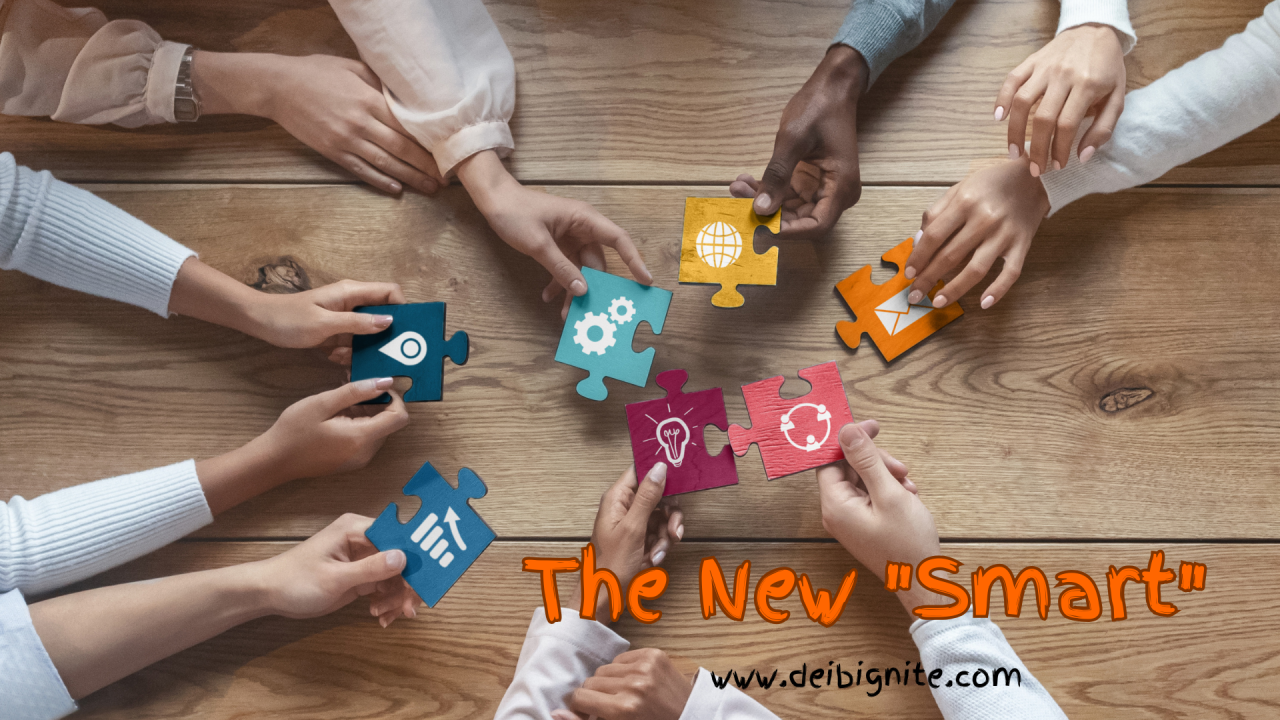
Solving the DEIB puzzle is one of the most complex leadership challenges of our time. Imagine six people, each holding one piece of an elephant — a leg, a trunk, a tail. Each person is completely right about their piece. Yet none of them can describe the whole animal. This is exactly where most organizations find themselves with DEIB today. Individual excellence, good intentions, and isolated initiatives are simply not enough. True progress demands collective harmony, systemic thinking, and a fundamentally new kind of intelligence. Welcome to the age of the New Smart.
Solving the DEIB Puzzle Starts With Understanding Your Brain
First, it helps to understand why smart, well-meaning people still make biased decisions. The answer lies in dual-processing theory, popularized by Nobel laureate Daniel Kahneman in Thinking, Fast and Slow. Your brain operates on two systems. System 1 is the Rabbit — fast, automatic, effortless, and deeply intuitive. System 2 is the Turtle — slow, deliberate, analytical, and energy-intensive. Both systems are essential. However, under pressure or stress, the Rabbit almost always wins.
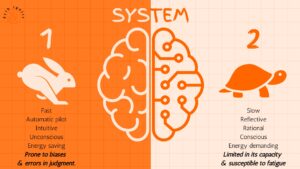
This matters enormously for inclusion. When leaders face tight deadlines, high stakes, or cognitive overload, they default to System 1 thinking. As a result, unconscious bias fills the gaps. Familiar patterns feel safe. Different perspectives feel like friction. Therefore, stress does not just affect performance — it actively shuts down inclusion at the neurological level.
Furthermore, organizations that fail to account for this cognitive reality build DEIB programs on unstable foundations. Training alone cannot override a stressed brain. Consequently, the environment itself must change.
| Attribute | System 1 — The Rabbit | System 2 — The Turtle |
|---|---|---|
| Speed | Milliseconds — near-instant | Seconds to minutes — deliberate |
| Energy Use | Very low — runs on autopilot | High — requires focused effort |
| Bias Susceptibility | Very high — pattern-matching drives decisions | Low — critical evaluation overrides shortcuts |
| Decision-Making Style | Intuitive, emotional, heuristic-based | Logical, evidence-based, structured |
| Role in Inclusion | Often excludes through familiarity bias | Enables equitable, considered choices |
What Is the New Smart? Consequential Wisdom Defined
Solving the DEIB puzzle in the age of artificial intelligence requires a new definition of intelligence altogether. For decades, organizations rewarded what we might call Mechanical Smart — the ability to process information quickly, optimize for efficiency, and produce measurable outputs fast. However, machines now do that better than humans ever will. Therefore, the competitive advantage has shifted.
The New Smart is Consequential Wisdom — the capacity to think beyond the immediate, to trace the downstream effects of decisions, and to weigh the human and systemic costs that spreadsheets do not capture. It asks not just “Does this work?” but “For whom does this work, and at what cost to everyone else?”
Short-Term Wins Versus Long-Term Costs
Consider AI energy consumption. Many organizations rush to deploy AI tools for competitive advantage. However, large language models consume extraordinary amounts of electricity and water. A 2023 University of Massachusetts study estimated that training a single large AI model can emit as much carbon as five cars over their lifetimes. Additionally, AI data centres are accelerating water scarcity in drought-prone regions. These are not abstract concerns — they are consequential realities that Mechanical Smart ignores and Consequential Wisdom demands we address.
Similarly, short-term hiring decisions that bypass diverse talent pipelines may produce fast results. Nevertheless, they erode long-term innovation capacity and organizational resilience. Consequential Wisdom connects those dots before the damage is done.
Solving the DEIB Puzzle Through Smarter Organizational Design
Solving the DEIB puzzle at the organizational level means deliberately designing processes that engage System 2 thinking rather than hoping goodwill alone will do the work. According to Gallup research, only 36% of employees in the US feel engaged at work, and inclusion gaps remain a primary driver of disengagement. Therefore, structural interventions are not optional — they are essential.
Create Productive Friction in Decision-Making
Additionally, organizations should introduce intentional pause points into high-stakes processes. For example, structured interview scorecards, diverse hiring panels, and pre-mortem exercises all slow the Rabbit down. They force deliberate evaluation before final decisions are made. Furthermore, blind resume screening removes identity cues that trigger System 1 pattern-matching. These are not bureaucratic obstacles — they are cognitive health tools.
- Prioritize integration over isolation: DEIB must connect directly to talent optimization strategy, performance management, and leadership development — not sit in a separate HR silo.
- Build ethical AI literacy: Train leaders to interrogate algorithmic outputs for embedded bias, especially in recruitment, performance scoring, and promotion tools.
- Design for cognitive safety: Reduce chronic stress loads that trigger System 1 defaults — flexible work models, psychological safety norms, and manageable decision volumes all help.
- Measure inclusion as a performance metric: Use data to track belonging scores, promotion equity ratios, and representation at every leadership tier.
- Reward Consequential Wisdom explicitly: Recognize leaders who consider second- and third-order effects in their decisions, not just those who hit short-term targets fastest.
Practical Steps for Individuals Ready to Lead Differently
Solving the DEIB puzzle also requires individuals to do rigorous inner work, not just systemic advocacy. The most inclusive leader in the room is still capable of bias under pressure. Therefore, self-insight is non-negotiable.
First, identify your personal stress triggers. When do you default to autopilot? What situations cause you to rely on pattern-matching rather than deliberate evaluation? Naming those triggers is the first step toward interrupting them. Second, cultivate self-insight as a daily practice rather than a one-time workshop experience. Journaling, peer coaching, and 360-degree feedback are all effective tools for building this muscle over time.
Seek the Invisible Consequences
Moreover, develop a habit of asking: “Who is not in this room, and how does this decision affect them?” Inclusive leadership is not passive — it actively searches for missing perspectives. Additionally, practice intellectual humility. Recognize that your piece of the elephant, however accurate, is still only one piece. Furthermore, seek out colleagues whose experiences differ from yours and treat their insights as essential data, not optional input.
- Track your decisions over time and audit them for patterns of exclusion or bias
- Practice solving the DEIB puzzle in everyday micro-decisions, not just formal processes
- Build a personal board of advisors who represent perspectives your background does not naturally include
Mechanical Smart Versus Consequential Wisdom: The Leadership Gap
Mechanical Smart values speed, certainty, and optimization. Consequential Wisdom values nuance, humility, and long-range thinking. Both have their place. However, in a world of compounding complexity — where AI, climate, demographic shifts, and geopolitical instability intersect — organizations that rely solely on Mechanical Smart will repeatedly miss what matters most.
Inclusive leadership is not a soft skill. It is a cognitive competency. It requires leaders to hold multiple truths simultaneously, resist the seduction of easy answers, and stay curious when certainty feels most tempting. In fact, solving the DEIB puzzle is less about having all the answers and more about being the kind of thinker who asks better questions.
Furthermore, talent optimization in 2026 means recognizing that your most valuable organizational asset is not your fastest thinker — it is your wisest one. Therefore, leadership evaluation criteria must evolve to reward Consequential Wisdom alongside technical expertise and execution speed.
Frequently Asked Questions
What is the New Smart in the context of DEIB and Talent Optimization?
The New Smart refers to Consequential Wisdom — the ability to think beyond immediate results and consider the downstream human and systemic effects of decisions. In the context of DEIB and talent optimization, solving the DEIB puzzle now requires this kind of long-range, ethically grounded intelligence rather than pure speed or technical efficiency. It is the leadership competency that machines cannot replicate and organizations urgently need to cultivate.
How does stress impact inclusion and decision-making at work?
Stress activates System 1 thinking — the brain’s fast, automatic mode. Under pressure, leaders default to familiar patterns and unconscious bias fills decision gaps. Therefore, inclusion suffers most precisely when stakes are highest. Organizations must reduce chronic cognitive overload and design structured decision processes to protect equitable thinking. Psychological safety and manageable workloads are not perks — they are neurological necessities for inclusive leadership to function effectively.
What is the difference between Mechanical Smart and Consequential Wisdom?
Mechanical Smart optimizes for speed, efficiency, and measurable outputs. Consequential Wisdom asks who benefits, who is harmed, and what the second- and third-order effects will be. Solving the DEIB puzzle requires moving from Mechanical Smart toward Consequential Wisdom. One values the fastest answer — the other values the most humane and sustainable one. In 2026, the most effective leaders combine both, but prioritize wisdom when complexity demands it.
How can organizations design processes to engage System 2 thinking?
Organizations can engage System 2 thinking by introducing productive friction into high-stakes decisions. For example, structured hiring rubrics, diverse evaluation panels, blind resume screening, and pre-mortem risk analyses all slow reflexive decision-making. Additionally, reducing chronic stress loads — through psychological safety norms and sustainable workloads — preserves cognitive bandwidth for deliberate thinking. Solving the DEIB puzzle organizationally means making System 2 engagement the default, not the exception, in critical processes.
Why is Ethical AI literacy important for inclusive leadership?
AI systems are trained on historical data, which means they can encode and amplify existing biases at scale. Therefore, inclusive leaders must develop the literacy to interrogate algorithmic outputs critically. Solving the DEIB puzzle in an AI-enabled workplace means understanding that a tool’s speed and precision do not guarantee its fairness. Leaders who treat AI outputs as neutral facts — rather than as outputs requiring ethical scrutiny — risk accelerating exclusion while believing they are being objective and data-driven.