Courage in leadership is the single most underused resource in senior leadership today — and the gap it creates is costing organizations more than they realize. It is not a shortage of strategy, skill, or experience that holds leaders back. It is the hesitation to act on what they already know is right. The direct answer is this: leaders who close that courage gap consistently outperform, out-innovate, and outlast those who don’t. And with the right behavioral tools, that gap is completely closeable.
What Courage in Leadership Really Means
Courage in leadership is the deliberate willingness to act on what you know is right, even when doing so is uncomfortable, unpopular, or uncertain. It is not recklessness. It is not bravado. It is the daily practice of saying what needs to be said, making the call that needs to be made, and asking the hard questions — even when silence would be easier.
Courage in leadership shows up in the small moments. It lives in the honest performance conversation you don’t soften. It lives in the meeting where you challenge the consensus rather than nod along. These moments feel minor in isolation. However, they compound over time into culture, trust, and competitive advantage.

Most senior leaders are extraordinarily capable. They have navigated complexity, built high-performing teams, and delivered results through sustained effort. Yet, time and again, what holds them back is not a lack of vision — it is a reluctance to say or do what they already know is necessary. The environment has gradually made the cost of honesty feel higher than the cost of silence. And that calculation becomes so automatic it stops feeling like a choice.
- Courage is a daily practice, not a one-time act
- It distinguishes leaders who maintain the status quo from those who drive real change
- It creates the psychological safety that fuels innovation and belonging
- It is measurable, learnable, and directly linked to organizational performance
Why Courage in Leadership Is So Underused
Courage in leadership is underused because modern workplaces have, often unintentionally, rewarded compliance over candor. Leaders learn — consciously or not — that silence is safer than honesty. The higher they climb, the more they feel the weight of expectations, the fear of failure, and the pressure to maintain harmony at all costs.
This is not purely a personal failing. It is a systemic issue. Organizations that prioritize short-term results over long-term health create environments where leaders feel forced to choose between truth and survival. Over time, that erodes trust, stifles innovation, and turns enormous potential into missed opportunity.
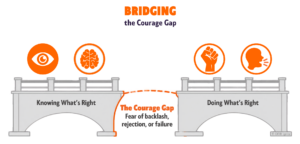
The irony is sharp. Most leaders already know what needs to be said or done. They see the problems. They spot the inefficiencies. They recognize the unspoken truths hanging in the room. But the fear of backlash or rejection keeps them quiet. And that silence accumulates — in poor decisions made without critical information, in disengaged teams, and in the growing distance between the leader people see and the leader they could be. Research from HarvardBusiness Review consistently shows that leadership avoidance behaviors directly damage team performance and organizational health.
The Systemic Barriers That Kill Courageous Leadership
Several structural forces work against courage in leadership. Performance systems that punish failure discourage bold action. Cultures that prize consensus over constructive dissent silence the most important voices. Leaders who were promoted for technical brilliance often receive little development in the interpersonal courage required at senior levels. Additionally, without accurate self-awareness, leaders cannot even see where their courage is failing.
The Real Cost of the Courage Gap in Organizations
When courage in leadership is absent, organizations pay a price that is often invisible until it becomes catastrophic. The accumulation of avoided conversations and deferred decisions slowly hollows out a team’s trust and capability. Furthermore, the damage spreads far beyond the leader’s immediate circle.

This is why understanding leadership behavior toxicity matters so much. When courage is absent at the top, toxicity fills the vacuum. Unhealthy norms solidify. High performers leave. And the leaders who remain learn to survive rather than thrive.
- Missed information: Decisions made without the full picture lead to poor outcomes and wasted resources
- Stifled innovation: Teams stop sharing bold ideas when they fear rejection or ridicule
- Eroded trust: Employees disengage when leaders prioritize politics over honesty
- Lost talent: Top performers leave when their voices consistently go unheard
- Compounding silence: One avoided conversation makes the next one feel even harder
The alternative is clear. Leaders who model courage in leadership — who say what needs to be said and create spaces where others feel safe to do the same — build organizations that outperform. This connects directly to the behavioral profiling work explored in our pillar article: Behavioral Profiling for Success: The 2% Edge Explained. That 2% edge is often exactly this: the courage to act on what you already know.
Courageous Leadership vs. Leadership Without Courage
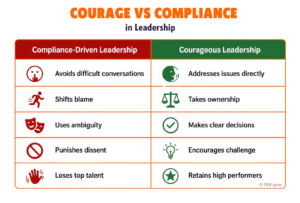
The difference between leaders who operate with courage and those who don’t is not always obvious from the outside. However, the organizational impact is measurable and stark. The following comparison highlights how courage in leadership shapes the environments leaders create.
| Leadership Without Courage | Courage in Leadership |
|---|---|
| Avoids difficult conversations to preserve harmony | Addresses issues directly, even when uncomfortable |
| Shifts blame to protect reputation | Takes ownership of mistakes and models accountability |
| Uses ambiguity to avoid commitment | Makes clear decisions with available information |
| Punishes dissent, stifles new ideas | Encourages constructive challenge and bold thinking |
| Loses top talent to cultures that listen | Retains high performers in psychologically safe environments |
| Creates passive compliance in teams | Builds active engagement and collective ownership |
For leaders already navigating a toxic environment, the behavioral toolbox for combating leadership toxicity offers practical, research-backed strategies to start shifting the dynamic immediately.
How to Develop Courage in Leadership with Behavioral Profiling
Courage in leadership is not fixed — it is a skill that grows through self-awareness, practice, and the right tools. Behavioral profiling platforms like the Predictive Index provide leaders with valid, reliable, and actionable insights into their natural drives, caution areas, and stress responses. This is not about changing who you are. It is about understanding how you show up under pressure and adapting to lead more effectively.

A leader with high dominance and low patience, for example, might act impulsively under pressure. Behavioral profiling helps that leader recognize the pattern and develop strategies to pause, listen, and consider before acting. A leader with low assertiveness might consistently avoid difficult conversations. Profiling surfaces that tendency and builds the confidence to address issues directly. These are the 2% insights — the small but critical advantages that compound into exceptional leadership over time.
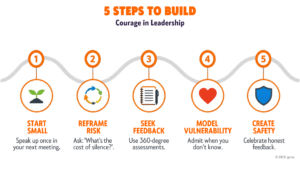
Five Practical Steps to Build Courage in Leadership
- Start small: Courage builds through consistent small actions, not grand gestures. Speak up once in your next meeting when you’d normally stay quiet.
- Reframe risk: Instead of asking “what’s the worst that could happen?” ask “what is the cost of not speaking up?” Silence carries risk too.
- Seek honest feedback: Use tools like 360-degree assessments and behavioral profiling to understand how your actions are actually perceived, not just intended.
- Model vulnerability: Admit when you don’t know something. Share what you’ve learned from mistakes. This gives others permission to do the same.
- Create psychological safety: Celebrate honest feedback, reward constructive dissent, and address toxic behavior head-on. Courage in leadership requires protecting the space where courage can grow.
It is also worth noting how courage connects to kindness. Honest leadership and compassionate leadership are not opposites — they are partners. Exploring kindness as a catalyst for inclusivity reveals how the two reinforce each other in high-performing cultures.
For a comprehensive foundation on using behavioral data to drive these outcomes, revisit the full guide: Behavioral Profiling for Success: The 2% Edge Explained.
Courage in Leadership and the Future of High-Performing Teams
Courage in leadership is increasingly critical as organizations navigate rapid change, AI disruption, and evolving workforce expectations. The leaders who will thrive are not those with the most data. They are the ones with the self-awareness and courage to act on it. Google’s Project Aristotle found that psychological safety — the direct product of courageous leadership — is the strongest predictor of high team performance.
Furthermore, as succession planning becomes more urgent for growing organizations, courage is one of the behavioral indicators that separates future-ready leaders from those who plateau. Identifying and developing this quality early is essential. That is precisely why succession planning redefined through behavioral DNA puts courage-related behaviors at the center of talent decisions.
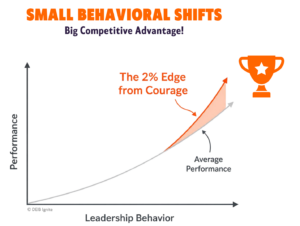
The organizations that invest in courage will be the ones that outperform the rest. Not because courage is inspirational — though it is — but because it is operationally effective. It leads to better decisions, stronger teams, and cultures where the best people choose to stay and grow.

Frequently Asked Questions
What exactly is courage in leadership?
Courage in leadership is the deliberate willingness to act on what you know is right, even when it is uncomfortable, risky, or unpopular. It is not recklessness or aggression. It is the practice of honest communication, decisive action, and creating the conditions where others feel safe to do the same. It shows up daily in small, consistent choices that compound into cultural strength over time.
How can I tell if I am lacking courage in leadership?
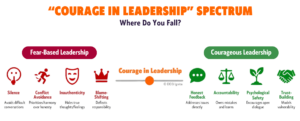
Ask yourself honestly: do you avoid difficult conversations to preserve harmony? Do you soften feedback to prevent discomfort? Do you stay silent when you see something that clearly needs to be addressed? If the answer is yes to any of these, fear may be overriding courage. The first step is recognizing the pattern — and behavioral profiling tools can make those blind spots visible and actionable.
Can courage in leadership be developed, or is it a fixed personality trait?
Courage in leadership is absolutely a learnable skill, not a fixed trait. It grows through self-awareness, deliberate practice, and consistent small actions over time. Tools like the Predictive Index give leaders accurate insight into their natural behavioral drives and stress responses. That self-knowledge is the foundation on which courageous behavior is built — reliably and sustainably.
How does courage in leadership impact organizational performance?
Organizations led by courageous leaders see measurably higher employee engagement, stronger innovation, lower turnover, and better decision-making quality. When leaders speak honestly and create psychological safety, teams share critical information, challenge weak ideas, and take the calculated risks that drive growth. The absence of courage in leadership, by contrast, silently drains performance through disengagement, missed opportunities, and avoidable errors.
What is the best first step to building courage in leadership?
Start with self-awareness. Use a behavioral profiling tool like the Predictive Index to understand your natural drives, blind spots, and how you respond under pressure. Then take one small courageous action this week — speak up in a meeting where you’d normally stay silent, give one piece of honest feedback, or admit one thing you don’t know. These micro-actions rewire your default responses and build courage as a genuine leadership habit.