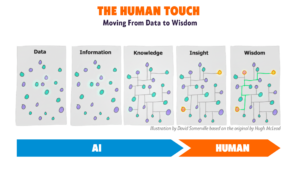
The Human Touch is the defining competitive advantage of the AI age — and the leaders who master it will outperform those who rely on data alone. Artificial Intelligence can process information faster than any human, predict trends with striking accuracy, and automate complex tasks at scale. However, AI cannot apply wisdom, sense team morale, or inspire people through a crisis. The direct answer is this: the human touch — combining empathy, ethical judgment, and meaning-making — is the irreplaceable skill that separates great leaders from sophisticated machines.
The Human Touch and the AI Paradox: Why Data Alone Is Not Enough
Artificial Intelligence can process information faster, analyze patterns deeper, and execute tasks more efficiently than any human. It can crunch terabytes of data in seconds, predict trends with uncanny accuracy, and even write reports or code. Yet, there’s one thing AI cannot do: apply wisdom.

The human touch becomes most valuable precisely when data is most abundant. We live in an era of extraordinary information access. Leaders have dashboards, analytics platforms, and AI-generated insights at their fingertips. Yet many organizations still struggle with disengaged teams, poor decisions, and stalled innovation. More data has not automatically produced better judgment.
As Daniel Pink famously argued, the future belongs to creators, empathizers, pattern recognizers, and meaning makers. These are fundamentally human capabilities. AI excels at computation and speed. However, it lacks the ability to understand emotional nuance, apply ethical judgment, or create genuine meaning for people in their work.

In a world where 85% of jobs in 2030 haven’t been invented yet (Dell Technologies), and 47% of current jobs will disappear (Oxford University), the ability to contextualize, empathize, and make meaningful decisions is no longer a soft skill—it’s a survival skill.
Furthermore, the World Economic Forum’s Future of Jobs Report 2025 highlights that 59% of the global workforce will require reskilling by 2030 — not only in technical areas but in deeply human skills like emotional intelligence, creativity, and complex problem-solving. Therefore, developing the human touch is no longer optional. It is a strategic imperative.
What Is Wisdom — and Why Does AI Lack It?
Wisdom is a multidimensional human capability that combines deep knowledge of self and world, empathic social intelligence, emotional regulation, and a genuine orientation toward the greater good. Professor Jennifer Jordan of IMD defines wisdom along four dimensions: cognitive, social, emotional, and motivational. Each dimension requires lived experience, reflection, and human relationship — none of which an algorithm can replicate.

Researchers Baltes and Smith identified five essential elements of wise decision-making. First, rich factual knowledge about human nature and life’s complexity. Second, procedural knowledge for solving real-world problems. Third, lifespan contextualism — understanding how circumstances evolve over time. Fourth, value relativism — genuinely acknowledging diverse perspectives. Fifth, the capacity to handle uncertainty and recognize the limits of one’s own knowledge.
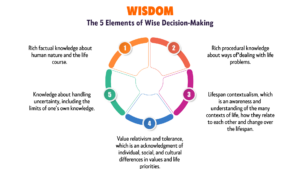
AI excels at the first two elements in narrow domains. However, AI fundamentally lacks the final three.
AI lacks the human ability to:
- Understand emotional nuances (e.g., a leader sensing team morale).
- Apply ethical judgment (e.g., balancing profit with social impact).
- Create meaning (e.g., inspiring a team through a crisis).
- Adapt to unpredictable human dynamics (e.g., navigating office politics with empathy).
AI It cannot hold two competing moral frameworks simultaneously and feel the tension between them. It cannot sense when a team is quietly losing faith. It cannot look a colleague in the eye and know that what they need right now is not a data point but a conversation. Additionally, it cannot inspire anyone to reach beyond what they thought was possible. These are the irreplaceable gifts of the human touch.
Table 1: Where AI Falls Short—and Humans Excel
| Capability | AI Strength | Human Strength (The Human Touch) | Why It Matters |
|---|---|---|---|
| Processing Speed | Analyzes terabytes instantly | Interprets meaning in context | Data without meaning drives poor decisions |
| Pattern Recognition | Identifies statistical trends | Imagines entirely new possibilities | Innovation requires human creativity |
| Task Execution | Automates repetitive work | Builds trust and genuine relationships | Engagement depends on human connection |
| Forecasting | Predicts likely outcomes | Weighs ethical and moral implications | Ethical judgment requires lived values |
| Optimization | Streamlines known processes | Navigates ambiguity and complex change | Adaptability is a human superpower |
The Human Touch as a 21st-Century Leadership Superpower
The human touch in leadership is what transforms raw data into decisions that actually move people. Consider Google’s landmark Project Aristotle research. It found that the single most important factor in high-performing teams was psychological safety — the freedom to take risks, share ideas, and be vulnerable without fear of judgment. No AI tool created that safety. A human leader did, through consistent, empathic, and courageous behavior over time.

Similarly, when organizations invest in kindness as a catalyst for inclusion and belonging, they unlock discretionary effort that no productivity software can manufacture. Kindness, trust, and genuine care are human-to-human transfers of energy. They fuel the psychological safety that drives innovation and retention.
Moreover, the human touch is what allows leaders to practice what researchers call value relativism — holding space for diverse perspectives without losing their own moral compass. In an increasingly complex, multicultural, and fast-moving business environment, that skill is priceless. Leaders who combine analytical rigor with genuine human wisdom consistently outperform those who rely on data alone.
The World Economic Forum’s Future of Jobs Report 2025 predicts that by 2030, 59% of the global workforce will require reskilling or upskilling—not just in technical areas, but in human-centric skills like:
- Emotional intelligence
- Critical thinking
- Creativity
- Complex problem-solving
- Social influence
These are the skills that AI cannot automate. In fact, the report highlights that 170 million new roles will emerge by 2030, while 92 million existing jobs will be displaced, making the need for human adaptability and wisdom more urgent than ever.
Where Human-Centered Leadership Delivers Results
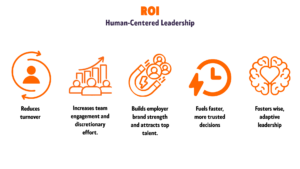
- The human touch reduces turnover — organizations with high psychological safety and strong relational leadership report significantly lower attrition rates.
- Emotional intelligence in leaders directly increases team engagement and discretionary effort.
- Purpose-driven, empathic leadership builds employer brand strength and attracts top talent.
- Leaders who practice active listening and empathic communication make faster, more trusted decisions.
- Behavioral self-awareness — knowing your own drives and blind spots — is the foundation of wise, adaptive leadership.
From Data to Wisdom: How to Cultivate the Human Touch
Cultivating the human touch is an active, ongoing practice — not a one-time training event.Wisdom isn’t something your acquire – it’s something you cultivate. Wisdom is built through experience, reflection, challenge, and mentorship. The good news is that every leader can develop it deliberately. Here are five evidence-based practices to move from data to wisdom in your organization.
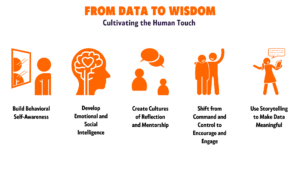
1. Build Behavioral Self-Awareness
You cannot lead others wisely until you understand yourself clearly. Behavioral profiling tools — such as the Predictive Index platform — provide valid, reliable, and immediately actionable insights into your behavioral drives, motivations, and blind spots. Understanding whether you are naturally high in Dominance, Extraversion, Patience, or Formality helps you predict your impact on others. Furthermore, it helps you adapt your approach with intention rather than autopilot.
2. Develop Emotional and Social Intelligence
Daniel Goleman’s Emotional Intelligence framework — covering self-awareness, self-regulation, motivation, empathy, and social skills — remains one of the most validated models for wise decision-making in leadership. Using behavioral profiling tools like the Predictive Index, can help you understand emotional drives in yourself and others. Additionally, practicing active listening, naming emotions in difficult conversations, and seeking feedback consistently all strengthen the human capacities that AI cannot replicate.
3. Create Cultures of Reflection and Mentorship
Wisdom deepens through dialogue and challenge. Organizations that build “trust cabinets” — small groups where leaders discuss real challenges openly — accelerate the development of collective wisdom. Cross-generational mentoring is equally powerful, as it shares diverse lived perspectives across experience levels. Scheduling regular reflection sessions to review both failures and successes embeds a learning culture that compounds over time.
4. Shift from Command and Control to Encourage and Engage
The future of leadership is less about hierarchy and more about collaboration and human activation. Organizations must move from push-style, top-down management toward learner-centric, psychologically safe environments, empowering employees to take ownership of their own learning and development.
This shift also supports more effective succession planning. Leaders who develop their people with wisdom and intention build deeper talent pipelines. Explore how behavioral insight transforms succession planning into a proactive, human-centered strategy rather than a reactive exercise.

5. Use Storytelling to Make Data Meaningful
Stories transcend spreadsheets. Narrative-based learning — using real case studies, personal journeys, and honest accounts of failure — is one of the most powerful ways to develop wisdom in teams. Leaders who share their own struggles and growth model the vulnerability that builds trust. Furthermore, stories embed insights into memory far more effectively than dashboards or reports ever can.
The Human Touch and Behavioral Profiling: Your 2% Edge
The human touch, combined with behavioral science, creates the marginal gains that separate good organizations from truly exceptional ones. At DEIB Ignite, we believe the biggest competitive advantages are not found in technology alone. They come from deeply understanding people — their drives, their fears, their strengths, and their potential.
The Predictive Index platform gives leaders the behavioral data they need. However, wisdom is what determines how that data gets applied. A leader might discover through behavioral profiling that a high-performing team member needs autonomy and creative challenge to thrive. The data reveals the insight. The human touch determines whether the leader acts on it with courage, care, and the right timing.
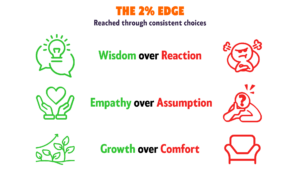
For individuals, this edge shows up as sharper self-awareness, stronger relationships, and greater resilience under pressure. For organizations, it manifests as higher engagement, faster innovation cycles, lower turnover, and a culture where people genuinely want to give their best. The 2% edge is not about dramatic transformations. It is about consistently choosing wisdom over reaction, empathy over assumption, and growth over comfort.
The Human + AI Partnership

- AI handles data, speed, pattern recognition, and process optimization.
- The human touch delivers wisdom, empathy, ethical judgment, and meaning-making.
- Together, they create organizations that are both analytically sharp and deeply human.
- Leaders who combine behavioral insight with genuine wisdom outperform peers who rely on either alone.
- The most future-ready organizations invest simultaneously in AI capability and human development.

Frequently Asked Questions
What exactly is the human touch in a leadership context?
The human touch in leadership refers to the set of distinctly human capabilities — empathy, ethical judgment, contextual wisdom, emotional intelligence, and meaning-making — that allow leaders to connect with, inspire, and develop other people. Unlike technical skills or data analysis, the human touch cannot be automated or replicated by AI. It is built through lived experience, self-awareness, reflection, and genuine care for others. It is the foundation of trust, psychological safety, and high-performing teams.
Why can’t AI replicate the human touch?
AI lacks the human touch because it cannot experience emotion, hold competing values in moral tension, sense unspoken team dynamics, or create genuine meaning for people. AI processes patterns and probabilities. However, wisdom requires lived context, ethical discernment, and the ability to respond to the full complexity of human relationships. These capabilities emerge from human experience and cannot be encoded into an algorithm, no matter how sophisticated the model becomes.
How does behavioral profiling support the human touch?
Behavioral profiling tools like the Predictive Index provide leaders with validated, reliable data about their own and others’ behavioral drives, motivations, and working styles. This self-knowledge is the foundation of the human touch — because you cannot empathize with others or adapt your leadership style without first understanding yourself. Behavioral profiling does not replace the human touch. Instead, it amplifies it by giving leaders actionable insight to apply with greater wisdom, precision, and empathy.
What are the most important human skills in the age of AI?
The most important human skills in an AI-driven world include emotional intelligence, critical thinking, creativity, complex problem-solving, ethical judgment, adaptability, and the ability to inspire and connect with others. The World Economic Forum’s Future of Jobs Report 2025 highlights all of these as top priorities for workforce reskilling by 2030. Furthermore, wisdom — the ability to integrate knowledge, experience, and values into sound decisions under uncertainty — sits above all of them as the master capability.
How can organizations start developing wisdom and the human touch?
Organizations can develop the human touch by investing in behavioral self-awareness tools, emotional intelligence training, mentorship programs, and cultures of psychological safety and reflection. Shifting leadership models from command-and-control to encourage-and-engage creates the conditions where wisdom can grow. Additionally, using storytelling and narrative-based learning embeds human insight into organizational memory. The human touch is not a one-time initiative — it is a continuous, deliberate practice that compounds in value over time.