DEIB prevents employee burnout in ways that the traditional resilience narrative simply cannot. For years, organisations have responded to burnout by asking employees to toughen up, adapt faster, and bounce back harder. However, that approach places the burden of a systemic problem on individual shoulders. Therefore, this article makes the case for a smarter, more human-centric alternative: embedding Diversity, Equity, Inclusion, and Belonging — alongside Active Allyship — as the structural antidote to burnout. The result is not just survival. It is a culture where every person genuinely thrives.
The Problem with the Resilience Narrative at Work
The resilience narrative at work tells employees to endure dysfunction rather than fix it. When organisations respond to burnout by promoting resilience workshops or mindfulness apps, they are treating symptoms while ignoring causes. Chronic overwork, exclusion, lack of psychological safety, and inequitable systems do not disappear because employees meditate more. Furthermore, asking marginalised groups to simply “be more resilient” compounds the harm — it asks them to absorb the weight of biased structures without challenging those structures at all.
Modern workforces are shifting their priorities decisively. Employees today demand purpose, balance, and genuine well-being — not just a pay cheque. A 2023 CNBC/SurveyMonkey poll found that 80% of employees value working for a company that prioritises DEIB. That statistic signals something important: the workforce is no longer willing to tolerate cultures that demand resilience in place of respect.
Additionally, the resilience-first mindset stifles organisational growth. When leaders frame burnout as a personal failure rather than a systemic signal, they miss opportunities to redesign work in ways that unlock real performance. The conversation must shift — from “how do we help employees cope?” to “how do we build workplaces where coping is rarely necessary?”
DEIB Prevents Employee Burnout Through Systemic Change
DEIB prevents employee burnout because it addresses the root causes rather than the symptoms. Diversity, Equity, Inclusion, and Belonging create the conditions where people feel psychologically safe, fairly treated, and genuinely valued. Consequently, employees in DEIB-centred workplaces experience lower chronic stress, stronger connection, and greater motivation — all of which are proven burnout buffers.
Psychological safety — the belief that you can speak up, take risks, and be yourself without fear — is foundational. When DEIB is embedded into culture, psychological safety is not accidental. It is built deliberately through equitable policies, inclusive leadership behaviours, and active accountability. Trust follows naturally, and trust reduces the exhaustion that comes from constant self-monitoring and fear of exclusion.
The contrast between resilience-driven and DEIB-centred workplaces is stark. The table below illustrates the key differences across several dimensions:
| Aspect | Resilience-Driven Workplaces | DEIB-Centered Workplaces |
|---|---|---|
| Focus | Individual coping and endurance | Systemic equity and belonging |
| Employee Well-Being | Reactive; addresses burnout after it occurs | Proactive; prevents burnout through inclusion |
| Innovation | Stifled by survival-mode thinking | Fuelled by diverse perspectives and safety |
| Retention | High turnover from disengagement and exhaustion | Strong retention through purpose and belonging |
| Employer Brand | Attracts employees who tolerate dysfunction | Attracts talent aligned with values and growth |
| Cost of Burnout | High — repeated replacement and lost productivity | Lower — investment in culture reduces attrition |
The Five Pillars of DEIB in Combating Burnout
The five pillars of DEIB each play a distinct and powerful role in reducing burnout and building sustainable well-being at work. Together, they form a comprehensive framework for organisational health. Drawing on insights from Leading Through Bias by Dr. Poornima Luthra and Prof. Sara Louise Murh, and The Art of Active Allyship by Dr. Poornima Luthra, these pillars move organisations from reactive to genuinely regenerative cultures.
Diversity of Thought
Diverse perspectives lead to more creative problem-solving and deeper employee engagement. When people feel their unique viewpoint is an asset — not a liability — they invest more fully. Moreover, teams that draw on varied experiences generate better solutions with less collective strain, reducing the exhaustion of homogeneous thinking loops.
Equity of Opportunity
Fair access to resources, recognition, and advancement eliminates a major burnout driver: the chronic stress of navigating unfair systems. Equity builds trust. Employees who believe the playing field is level can focus their energy on doing great work — rather than managing systemic disadvantage.
Inclusion and Belonging
Inclusion ensures that every contribution is genuinely valued. Belonging goes further — it is the felt sense of truly mattering within a group. Both reduce isolation and alienation, which are significant contributors to burnout. When people belong, they stay engaged, invested, and energised rather than depleted.
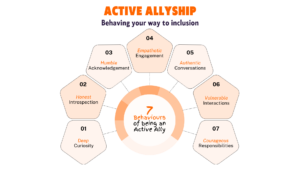
Source: “The Art of Active Allyship” by Dr. Poornima Luthra
Active Allyship
Active Allyship, as defined in The Art of Active Allyship, means using privilege and influence to advocate for others — consistently and visibly. Active allyship creates psychological safety by demonstrating that no one navigates bias or exclusion alone. Furthermore, DEIB prevents employee burnout most powerfully when allyship becomes a cultural norm rather than a personal choice, because it removes the invisible labour that marginalised employees carry every day.
- Speak up when exclusionary behaviour occurs, even in small moments.
- Amplify the voices of underrepresented colleagues in meetings and decisions.
- Educate yourself on the lived experiences of others rather than waiting to be taught.
- Take action to remove structural barriers within your sphere of influence.
- Reflect regularly on your own biases and the impact of your behaviour on others.
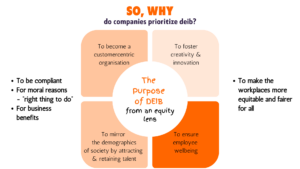
Source: “Leading Through Bias” by Dr. Poornima Luthra & Prof. Sara Louise Muhr
DEIB prevents employee burnout — and the financial and human costs that burnout generates — when organisations understand just how expensive the resilience-first model truly is. Research consistently shows that around 67% of employees experience burnout at some point in their careers. Furthermore, replacing a burned-out employee costs between half and double their annual salary, factoring in recruitment, onboarding, and lost productivity.
The erosion of well-being goes beyond performance metrics. Chronic workplace stress is strongly linked to serious health risks, including heart disease, diabetes, and compromised immune function. These are not abstract risks — they represent real human suffering and significant healthcare costs for both individuals and employers. Additionally, when employees operate in survival mode, creativity shuts down. Innovation requires psychological safety and cognitive space — two things that resilience-driven cultures systematically deplete.
In contrast, DEIB-centred cultures reduce these costs by addressing the upstream causes of burnout. Equitable workloads, inclusive leadership, and genuine belonging lower chronic stress before it becomes a crisis. Therefore, investing in DEIB is not a cost — it is a measurable return on human capital.
In summary, DEIB prevents employee burnout because it addresses the root causes rather than the symptoms. Behavioral profiling can help organizations understand the behavioral dynamics that contribute to stress and disengagement, enabling them to design more supportive, inclusive environments.
The Power of Purpose-Driven Workplaces
Purpose-driven workplaces are a direct outcome of strong DEIB cultures — and they deliver measurable performance advantages. McKinsey research indicates that employees who feel a strong sense of purpose are 21% more productive than those who do not. Furthermore, Gallup data shows that highly engaged employees are 59% less likely to look for a new job, dramatically reducing turnover and its associated costs.
Purpose buffers stress in a way that resilience training cannot replicate. When employees understand how their work connects to something meaningful — and feel genuinely included in that mission — they are far better equipped to handle challenges without burning out. Consequently, well-being improves not because employees are tougher, but because the work itself feels worthwhile.
Tools like the Predictive Index (PI) can help organizations align employees with roles that match their behavioral drives and cognitive abilities, ensuring that purpose is not just a concept but a lived experience.
Purpose-driven cultures also enhance innovation. When people feel safe enough to take risks and trust that their ideas are welcome regardless of their background, creativity flourishes. Moreover, diverse teams in psychologically safe environments consistently outperform homogeneous teams on complex, creative challenges. The link between DEIB, purpose, and innovation is not incidental — it is structural.
- Purpose increases intrinsic motivation and daily engagement levels significantly.
- Employees in purpose-aligned roles report lower stress and higher life satisfaction.
- Organisations with clear, inclusive purpose attract and retain top-tier talent more effectively.
- DEIB prevents employee burnout when purpose is shared equitably across all levels and identities.
Building a Future-Proof Culture Beyond Resilience
Building a future-proof culture means moving deliberately from a resilience mindset to one centred on DEIB, active allyship, and genuine belonging. This transition does not happen through a single training session. It requires consistent, courageous action at every level of an organisation. However, the steps are clear — and the organisations that take them will outperform those that do not.
First, embed DEIB principles into the operating system of your organisation — not as an add-on, but as a core design principle. That means reviewing hiring, promotion, pay equity, and workload distribution through an equity lens. Additionally, it means measuring inclusion and belonging as rigorously as you measure financial performance. McKinsey’s research on diversity and inclusion consistently demonstrates that organisations that prioritise equity outperform their peers across multiple dimensions.
Second, foster Active Allyship as an organisational behaviour — not just a personal value. Train leaders to recognise exclusion, amplify underrepresented voices, and model psychological safety in every interaction. When allyship is visible and consistent, it signals to every employee that the organisation is serious about belonging.
Third, prioritise open dialogue. Create formal and informal channels for employees to surface concerns, share experiences, and co-design solutions. Psychological safety is built in daily interactions — not just in annual surveys. Moreover, leaders who listen actively and act on what they hear build the trust that prevents disengagement and burnout from taking hold.
- Conduct regular equity audits across hiring, pay, and promotion decisions.
- Train leaders in inclusive behaviours, bias awareness, and active allyship practices.
- Establish psychological safety through consistent, values-aligned leadership behaviour.
- Measure belonging and inclusion alongside traditional performance metrics.
- Celebrate progress publicly and hold leaders accountable for DEIB outcomes.
The future of work is not about bouncing back. It is about building workplaces so fundamentally equitable, inclusive, and human-centred that burnout loses its grip entirely. DEIB prevents employee burnout — and it simultaneously unlocks the innovation, engagement, and loyalty that every organisation needs to thrive in 2026 and beyond.

Frequently Asked Questions
Why is resilience alone not enough to prevent employee burnout?
Resilience training addresses how individuals cope with stress but does not fix the systemic causes of burnout. Chronic overwork, exclusion, and inequitable treatment are organisational problems — not personal failings. Therefore, asking employees to simply be more resilient places an unfair burden on individuals while allowing dysfunctional systems to continue unchanged. DEIB prevents employee burnout by tackling the root causes directly.
How does DEIB prevent employee burnout in practice?
DEIB prevents employee burnout by creating conditions of psychological safety, equity, and belonging. When employees feel fairly treated, genuinely included, and supported by active allies, chronic stress decreases significantly. Furthermore, equitable workloads and inclusive leadership remove the hidden labour that marginalised employees disproportionately carry — which is one of the most overlooked drivers of burnout in modern workplaces.
What is Active Allyship and how does it reduce burnout?
Active Allyship, as defined by Dr. Poornima Luthra in The Art of Active Allyship, means consistently using your privilege and influence to advocate for others — especially those facing bias or exclusion. Active allyship reduces burnout by removing the invisible labour that marginalised employees bear alone. When allyship is a cultural norm, no employee navigates systemic barriers without visible, sustained support from colleagues and leaders.
What are the business costs of relying on resilience instead of DEIB?
Relying solely on resilience produces high burnout rates, costly employee turnover, and reduced innovation. Research shows that replacing a burned-out employee costs between half and double their annual salary. Additionally, chronic workplace stress links directly to serious health conditions, increasing absenteeism. In contrast, DEIB-centred cultures reduce these costs by preventing burnout proactively through equity, inclusion, and genuine psychological safety.
How can an organisation transition from a resilience mindset to a DEIB-centred culture?
Organisations can transition by embedding DEIB into core systems — hiring, pay, promotion, and performance management. Additionally, leaders must be trained in inclusive behaviours and active allyship, and psychological safety must be built through consistent daily actions. Measuring belonging as rigorously as financial performance signals serious commitment. DEIB prevents employee burnout most effectively when inclusion is structural, accountable, and visible at every level.